Trigger point dry needling

Dry needling for the knots that keep your pain going

Dry needling targets the tight, tender bands in muscle called trigger points. Brett Roberts was an early Wisconsin adopter of the technique, and it is one of the tools our Doctors of Physical Therapy use alongside exercise.

What a trigger point is, and why it gets its own treatment

A trigger point is a taut band inside a muscle, a knot that can be sore when pressed and can refer pain to a different spot. Physical therapists go looking for them when a neck, back or shoulder keeps aching and rest has not settled it.

At Roberts Physical Therapy your Doctor of Physical Therapy finds them by hand during the exam, after listening to your story. Dry needling is one way we address them. Not every patient needs it, and the exam decides.

How the needling is done

Brett Roberts, our president, was an early adopter of trigger point dry needling in Wisconsin and trained through Kinetacore. The technique uses a thin, sterile, single-use needle with no medication in it, which is where the word dry comes from.

Before your first session, read the Dry Needling Information Sheet in our patient forms. It puts the technique in writing so you can bring your questions to the clinic in Amherst, Plainfield or Wisconsin Rapids.

Where it fits in a plan of care

Needling is one part of care, not a stand-alone fix. Your therapist pairs it with manual therapy and exercise-based rehab so the work you do between visits carries it forward.

At the Wisconsin Rapids walk-in clinic it is an optional $25 add-on. For ongoing care we accept insurance, so call (715) 803-7617 and ask how dry needling is handled for your plan.

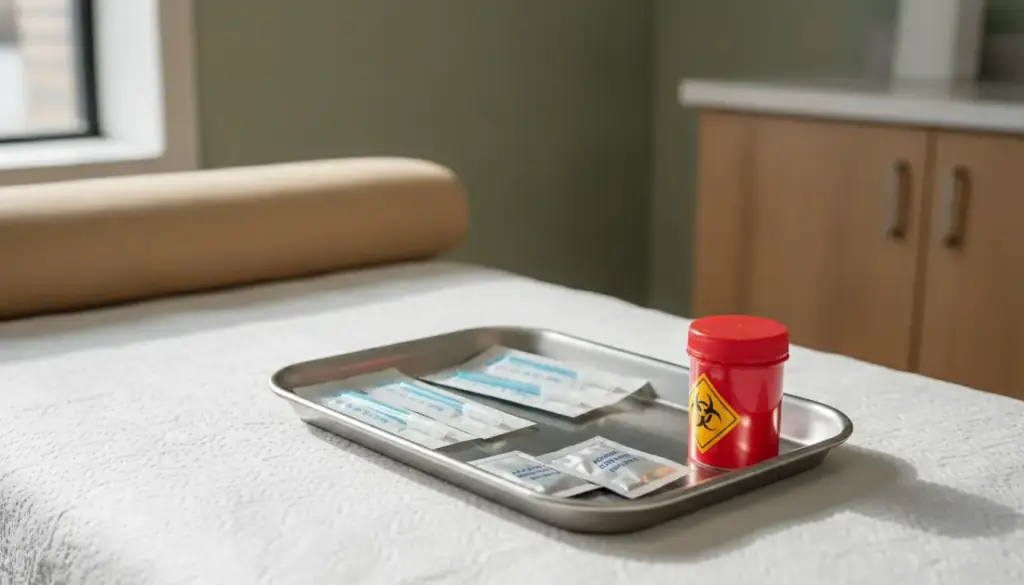
Steel instrument tray with sealed sterile needle packs, prep pads and a sharps container on a paper-covered table

Steel instrument tray with sealed sterile needle packs, prep pads and a sharps container on a paper-covered table

Roberts Physical Therapy, Wisconsin Rapids. Call (715) 803-7617.

Before you come in

Three things to know about your first needling visit

The paperwork lives on our patient information page. Questions before you book? Call (715) 803-7617.

  1. Read the sheet first

    The Dry Needling Information Sheet is one of our patient forms. Read it at home so your questions are ready when you walk in.

  2. Tell your therapist where it hurts

    The exam comes before any needle. Your therapist listens to your story, then checks the muscles to find out whether needling belongs in your plan.

  3. Add it at the walk-in clinic for $25

    In Wisconsin Rapids the walk-in evaluation and treatment is $250 self-pay, and dry needling is an optional $25 add-on.

Treatments that work alongside it